Okay!
After settling in Paris, I decided that it was time to find a place where I could continue my sailing practice. My sailing experience started 26 years ago when I started sailing small monohull dinghy sailboats on the Charles River in Boston. I learned a lot more about sailing Laser sailboats in Dubai, but then my training shifted to larger sailing yachts, anywhere from 28-50 feet in length, equipped with an in-board motor. I went quite far in training and experience on sailing yachts, including an Atlantic crossing and a bareboat charter in Greece.
But I have been looking for an opportunity to get back into the smaller boats…and since my new home is within the Paris city limits, small boat sailing is much more prevalent since we are no longer sailing on the open sea.
After lots of internet research and looking up opportunities to join different sailing clubs all around the suburbs of Paris (Île de France), even visiting 4 clubs in person, I found a place where I could get on a Hobie Cat in a Lake — it is the Île de France Olympic Stadium in the town of Vaires-Torcy.
The team there allowed me to join a 2-hour group course for only 40 EUR. Since I have plenty of small boat experience, I was fairly confident that I could figure things out even though I had never been on a small sailing catamaran before.
The Location
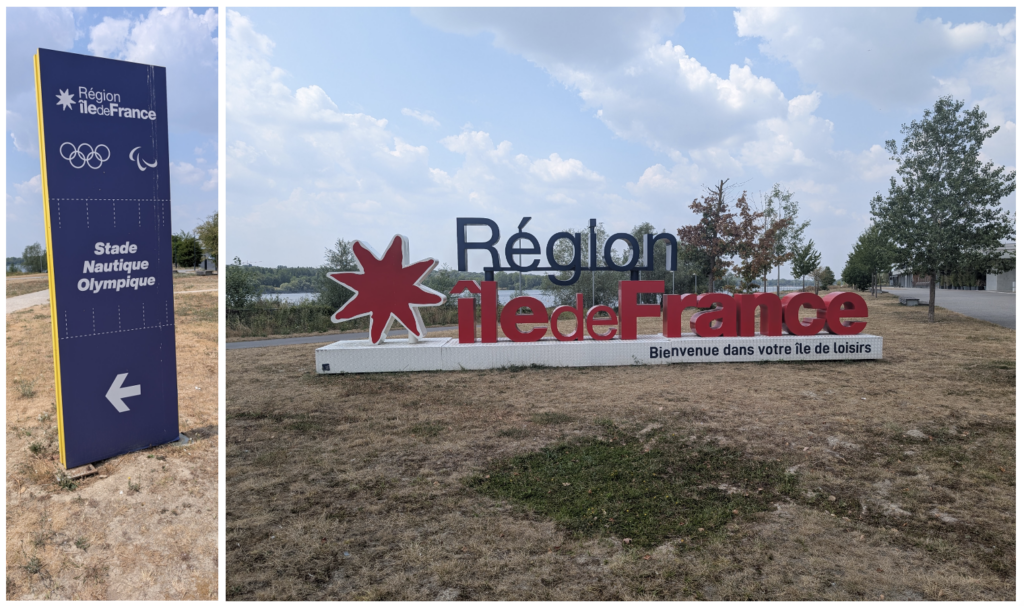
The Olympic Stadium in Île de France is a water sports complex whose grounds look pretty run down now that it has been over a year since the Paria Summer Olympics– wild, overgron brown grass, chipped paint on the pavement, etc. But the actual area to rent out boats and take courses is still fairly well-maintained.

Getting the Boat in the Water
The group course was with an older French guy named Sammy, and there were 5 of us in the course.
To get started you take a safety vest, a rolled-up mainsail, and the mainsheet control system (mainsheet = « l’écoute de la grande voile », or just « l’écoute »). Optionally you can take a tiller rod and a belt attachment allowing you to hike way out using your feet. I left with just the sail and tiller and mainsheet control, and made my way down to the catamarans.
The cats were sitting on the dock, with the foresails furled up and no mainsail.
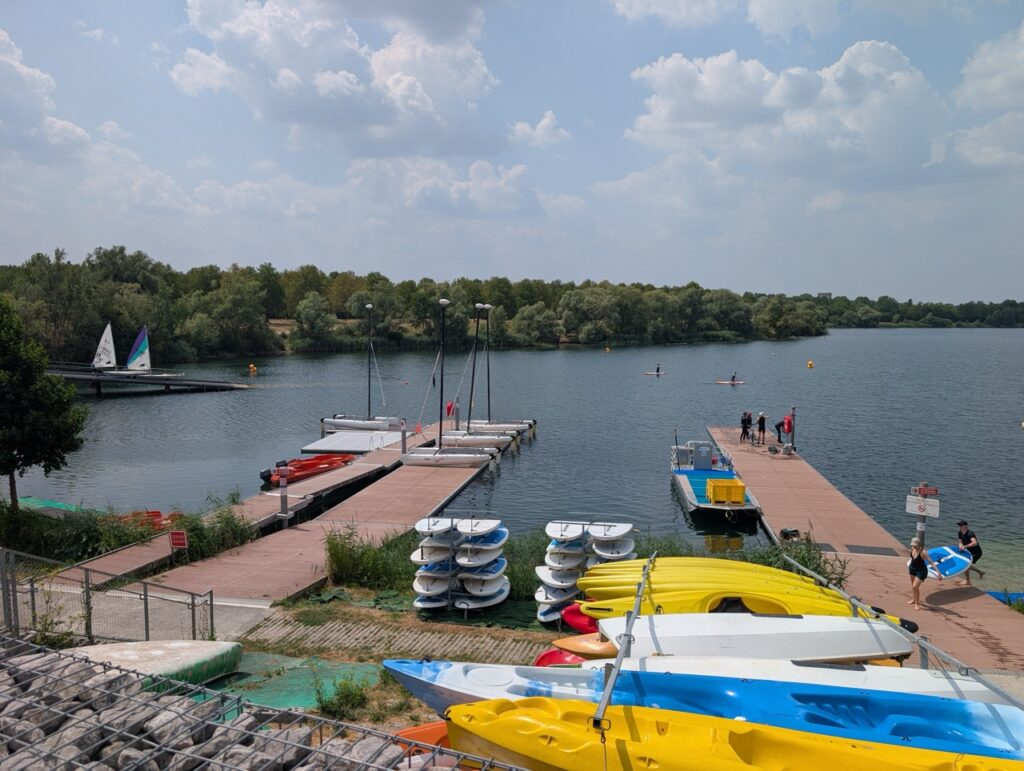
To get the boat prepared, « gréer le bateau » in French, there are the following steps:
- Point the boat into the wind
- Release the jib (« le foc ») furling line and use it to unfurl the jib.
- Attach the halyard (« la drisse ») to the ring at the head of the mainsail (« le point de drisse » de « la grande voile »), insert the bolt rope (« la ralingue ») along the luff (« la chute / le bord de fuite ») of the mainsail into the track in the mast (« le mat »), and use the halyard to hoist the mainsail to the top of the mast — ensuring the mainsail bolt rope stays in the track the whole time. Secure the halyard on the mast cleat (« taquet ») closest to centerline with a cleat hitch (« nœud de taquet »).
- Tuck the bottom part of the mainsail bolt rope in the bottom part of the track, and tug on the downhaul line to get the luff of the mainsail taut. Thread the Cunningham line into its fairlead (« filoire ») then to its cam cleat (« taquet coinceur à came ») and lock the cam cleat down.
- Attach the mainsheet control block system to the fixed eyelet at the stern (« la poupe ») of the boat, but do not attach the other side to the mainsail yet– you’ll do this only once in the water.
- Connect the tiller (« la barre ») bar to the rudder control bar at the stern of the boat.
Those are the steps to « gréer le bateau ». With all that done, you can now push the boat off the dock and into the water.
The course
To help the four catamarans get quickly to where the wind was, we tied up all the cats together, connecting the bow line of each boat to the line at the stern of the boat ahead, with the head cat tying its bow line to the stern of the instructor’s motor launch. Once out in the lake and untied from each other, we all followed a course laid out by the instructor. By which I mean to say, that most of the time the goal is to follow behind the instructor’s boat, until he stops, at which point you steer around him and then head back the other way.
For the first 20 minutes or so, we had some nice breezes so I was able to get up a pretty good speed on both downwind and upwind tacks. I had to get a reminder from the instructor to mind my jib, as I had forgotten to clean it up and it was on the wrong side. It’s funny because on a Hobie cat, the foresail handling is very similar to a larger sailing yacht, just the controls are much smaller. So I just had to remember out how to “uncleat” the jib sheet from the port side, and cleat it off on the starboard side. On the Hobie cat you uncleat the port-side jib sheet by releasing the port side jib cam cleat (yank down hard on it), Then you yank hard on the starboard side jib sheet to move the jib to the starboard side, which also secures the jib sheet similar to cleating it off.
It is a bit tricky to handle the 3 controls simultaneously — the tiller, jib sheet and mainsheet. But after the course was over the instructor explained that you really only need to worry about the mainsheet and tiller–once you have the jib set and its sheet secured in the cam cleat, you can forget it and focus on steering and trimming the mainsheet.
I was able to get some good cruising going for 2 or 3 good runs…and then the wind died :(.
The wind’s dying started to mark the end of the course, really. To pass the time, the instructor showed us how to raft up the four cats, then we each jumped in the water and learned the safe way to get back on to the boat from the water (either by the side, or by swimming under the trapeze and being hosted near the bow of the boat).
When it was time for us to head back, we were able to find enough wind to sail back to the docks. But I had to play around a bit because we needed to dock one at a time. At the end I had to get towed back to the dock because I came very close to a post in the water without realizing it, and I had very little maneuverability since the wind died again.
But the last bit was simple, dropping sail and tidying up the boats was straightforward, and we were all reatively quickly ready to head back to base and stow away all of the gear.
Final Thoughts– a new Sailing Home ?
All in all it was a great outing — I was able to get on to a Hobie cat for the first time, I was able to get some good speed in light to moderate wind, and I was able to get connected in to a sailing group and instructor who seems excited to get his students / crew out on the water on some good wind!
Who knows, maybe I’ll join up and make this my new dinghy sailing home !